
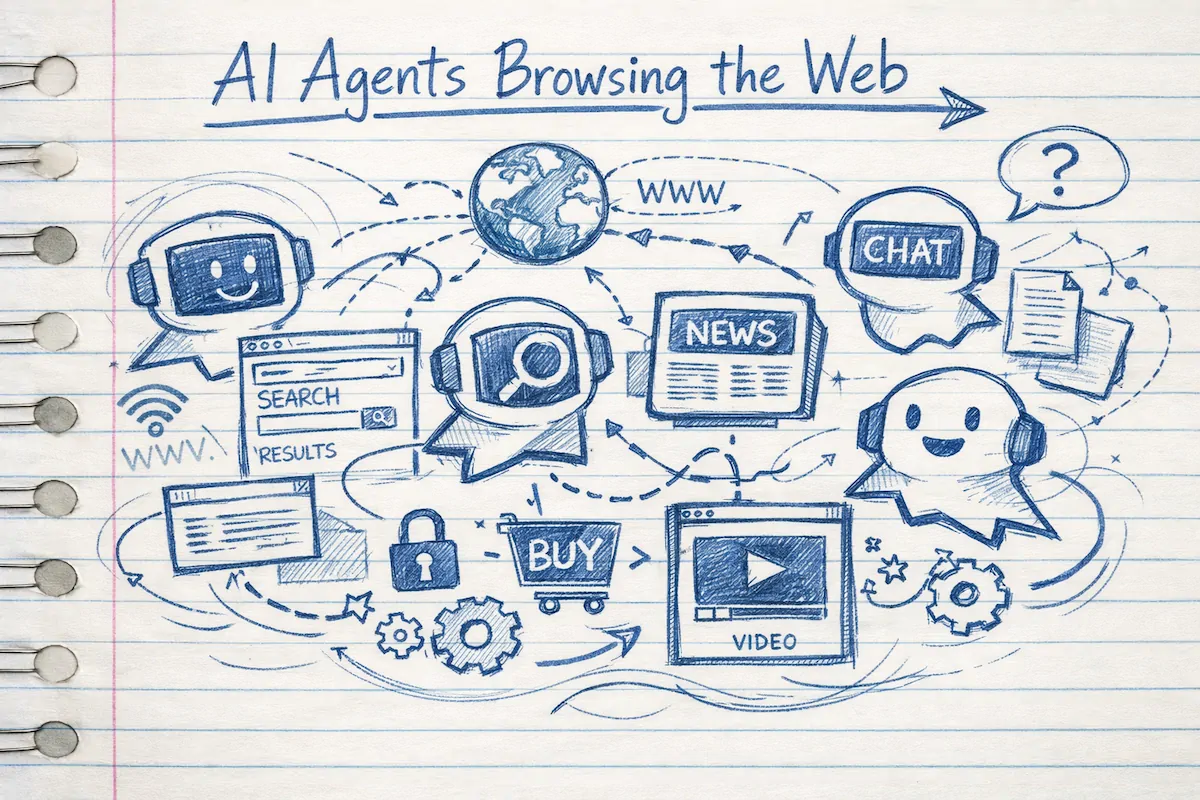
Over half of all web traffic is now generated by bots. AI crawlers from OpenAI alone have grown by 305% in the past year. Google's Project Mariner can juggle ten browsing tasks simultaneously. Anthropic's Claude lives inside Chrome, booking meetings and filling out forms. OpenAI's Operator navigates websites, clicks buttons, and completes purchases, all without a human touching the keyboard.
And yet, when any of these agents land on your website, they're greeted by the same thing every human visitor sees: a cookie consent banner asking them to make a choice about personal data.
Here's the uncomfortable question: who is actually consenting?
The Web Was Designed for Humans
Every major privacy regulation (GDPR, CCPA, Brazil's LGPD, and dozens of others) was written with a fundamental assumption: the entity visiting a website is a human being. The entire consent framework depends on it.
Under GDPR, consent must be:
- Freely given: not coerced or bundled
- Specific: tied to a clear purpose
- Informed: the person understands what they're agreeing to
- Unambiguous: requiring a clear affirmative action
Notice the language: person, understands, agreeing. These are inherently human concepts. A large language model processing a cookie banner doesn't "understand" privacy trade-offs the way a person does. It doesn't have personal data to protect. It doesn't have preferences about whether its browsing habits are tracked for advertising.
When an AI agent clicks "Accept All" on a cookie banner, is that valid consent? Almost certainly not under current law. But the website has no reliable way to know the difference.
The New Visitors Don't Look Like Bots
Traditional bots were easy to spot. They had recognisable user agents, made requests at inhuman speeds, and ignored JavaScript entirely. A simple bot-detection script could filter them out.
AI browsing agents are different. Tools like OpenAI's Operator and Google's Project Mariner use real browser engines. They render JavaScript, interact with DOM elements, scroll pages, and click buttons, just like a human would. Anthropic's Claude for Chrome literally operates within a standard Chrome browser session.
These agents are designed to be indistinguishable from human visitors. That's the entire point. They need to interact with websites the way people do, or they can't accomplish their tasks.
This creates a fundamental problem for consent management: your cookie banner can't tell if it's talking to a person or a machine.
When AI Agents "Consent," What Actually Happens?
Let's trace through what happens when an AI agent encounters a cookie banner:
- The agent lands on a page and detects a consent dialog blocking content
- It needs to dismiss the banner to complete its task (researching a product, comparing prices, filling a form)
- It clicks "Accept All" because that's the fastest path to the content, or it might click "Reject All" if it's been instructed to
In either case, no genuine consent decision has been made. The agent is optimising for task completion, not making an informed privacy choice. If it accepts, tracking cookies fire, analytics record a "visit," and ad networks may serve retargeted ads to nobody.
If it rejects, the website loses potential data from what it believes is a real user interaction, potentially skewing consent rate analytics.
Research shows that automated consent tools already create legal uncertainty. Browser extensions like "I Don't Care About Cookies" and Consent-O-Matic behave very differently. Some reduce tracking, while others actually increase cookies and HTTP requests. The legal validity of automated consent, whether by extension or AI agent, remains uncharted territory.
The Expectations Gap
Here's where it gets interesting for website owners. Privacy regulations don't just impose obligations on how you collect consent. They also assume certain things about who you're collecting it from.
Websites are expected to serve humans. That assumption is baked into:
- Accessibility requirements: regulations increasingly require that consent banners be accessible to people with disabilities
- Language and transparency rules: consent notices must be written in plain, understandable language
- Age verification: some jurisdictions require parental consent for minors
- Record-keeping: you must store proof that a specific person consented at a specific time
None of these make sense when the "visitor" is an AI agent acting on behalf of a user who may be thousands of miles away, browsing dozens of sites simultaneously, and never actually seeing your consent banner.
The expectation of a human on the other end is higher than ever. Regulators are cracking down on dark patterns, demanding clearer language, and requiring genuine choice. The bar for what constitutes valid human consent keeps rising, while the percentage of "visitors" who are actually human keeps falling.
What This Means for Your Consent Data
If you're running a website today, AI agent traffic is already affecting your analytics and consent metrics in ways you might not realise:
- Inflated consent rates: agents clicking "Accept All" to clear banners create phantom consent records
- Skewed analytics: bot visits mixed with human visits make it harder to understand real user behaviour
- Compliance risk: storing "consent" from a non-human entity doesn't satisfy GDPR requirements, but it's sitting in your consent logs
- Ad spend waste: tracking pixels firing on agent visits mean you're paying for impressions and data collection that targets nobody
The Imperva Bad Bot Report found that bad bots alone comprised 37% of internet traffic in 2024, up from 32% the year prior. Add legitimate AI agents from major tech companies, and the share of non-human traffic becomes staggering.
The Regulatory Blind Spot
Privacy regulators are focused on making consent better for humans, cracking down on dark patterns, requiring equal prominence for "Accept" and "Reject" buttons, and pushing for granular cookie categories. These are all worthy goals.
But there's a glaring blind spot: none of this addresses the fact that a growing share of website visitors aren't human at all.
The EU AI Act, which came into force in 2024, addresses AI transparency and risk management, but it doesn't specifically tackle the intersection of AI agents and cookie consent. GDPR enforcement bodies like the UK ICO are even deploying AI tools to detect non-compliant banners, while AI agents are simultaneously visiting those same sites and interacting with those same banners.
We're in a strange regulatory moment where:
- Humans face increasingly strict consent requirements
- AI agents face essentially no consent framework at all
- Website owners are caught in the middle, unable to reliably distinguish between the two
What Needs to Change
The web needs a way to handle AI agent traffic differently from human traffic when it comes to consent. Some possibilities:
1. Agent identification standards
AI agents should identify themselves. Just as ethical web crawlers use descriptive user agent strings (like Googlebot), AI browsing agents should signal that they're not human. OpenAI's Operator and Google's Project Mariner could adopt standardised headers that consent management platforms recognise.
2. Machine-readable consent policies
Instead of visual banners, websites could offer machine-readable privacy policies (like robots.txt for consent) that AI agents can parse programmatically. This would let agents understand a site's data practices without needing to interact with a visual UI designed for humans.
3. Consent exemptions for non-human visitors
If a visitor is verifiably a non-human agent, consent requirements designed for human data protection may not apply. Regulators could clarify that AI agent interactions don't constitute valid consent and shouldn't be counted in compliance records.
4. Better bot detection in consent platforms
Consent management platforms (like CookieChimp) can evolve to detect and handle AI agent traffic separately, filtering it out of consent analytics, preventing phantom consent records, and giving website owners a clearer picture of their real human audience.
The Humans Who Do Visit Have Higher Expectations Than Ever
There's another side to this story that's easy to miss. As AI agents handle more of the web's browsing, research, and information-gathering tasks, the humans who do land on your website are there with a very specific purpose.
People aren't visiting websites to casually browse anymore. They're asking ChatGPT, Perplexity, or Claude for information instead. When a human actually navigates to your site in 2026, they're there to do something: make a purchase, sign up for a service, book a demo, submit a form, contact your team. They've already done their research elsewhere. They're ready to act.
This shift has a direct consequence for your consent experience. These visitors have zero patience for anything that gets between them and their goal. They expect your website to be fast, polished, and frictionless. They expect a premium experience, because if your site feels slow, clunky, or obstructive, they'll leave. There are plenty of alternatives a chatbot can suggest.
Your cookie consent banner is the very first interaction most of these visitors have with your brand. It loads before they see your hero section, your product, or your pricing. If it's slow, ugly, confusing, or deliberately manipulative, you've already lost trust before the relationship has even started.
This is why consent banner UI/UX matters more now than it ever has. In a world where AI agents handle the browsing and humans only show up to take action, every pixel of friction counts. Your consent banner isn't just a legal checkbox. It's a first impression.
Why CookieChimp Is Built to Get Out of the Way
This is exactly how we think about consent at CookieChimp. We recognise that your visitors are never there to interact with a cookie banner. Nobody wakes up excited to manage their cookie preferences. They're on your site for what you do best: your product, your service, your content.
Our job is simple:
- Load instantly. CookieChimp is engineered for speed so your consent banner never slows down your page
- Collect the consent that's legally required. Privacy regulations still matter, and compliance protects your business
- Communicate user preferences to your vendors. The tools and services on your site respect each visitor's choices
- Record consent as proof of compliance. Creating the audit trail regulators expect
- Get out of the way as fast as possible. Your visitors can get on with whatever they came to do
We don't believe in dark patterns, manipulative design, or consent banners that feel like obstacle courses. We believe in clean, fast, respectful consent experiences that treat your visitors like the intentional, goal-driven people they are.
The Bottom Line
The web is experiencing a fundamental shift. AI agents now handle a growing share of web traffic, and the humans who do visit your site arrive with purpose and high expectations. But the entire consent infrastructure (the legal frameworks, the cookie banners, the compliance records) still assumes every visitor is human.
AI agents are getting better at browsing the web like humans. Consent was never meant for machines, and it needs to evolve to account for them. But while the industry figures that out, one thing is already clear: consent banners are still for humans, and today's humans expect better.
Your consent experience is the first thing a visitor sees. Make it fast. Make it clean. Make it respectful. And then get out of the way so they can do what they came for.