

Quebec
Quebec Law 25
Law 25 requires prior notice before technology identifies, locates or profiles a visitor. Create a Quebec-specific opt-in banner and fully customise its design, content and bilingual English/French experience.
Opt-in

Detect each visitor's province and automatically serve the right consent model — Law 25 opt-in in Quebec and opt-out where PIPEDA permits it elsewhere.








Create a fully customisable banner for every Canadian region, then apply the appropriate Law 25, provincial PIPA, PIPEDA or health-law consent model to each one.
Quebec Law 25
Law 25 requires prior notice before technology identifies, locates or profiles a visitor. Create a Quebec-specific opt-in banner and fully customise its design, content and bilingual English/French experience.
Provincial PIPA
Create separate banners for Alberta and British Columbia. Their private-sector laws allow notice-and-decline for non-sensitive tracking when visitors have a clear, reasonable opportunity to opt out.
PIPEDA + provincial health laws
Configure an independent banner for every remaining region. Apply PIPEDA's meaningful-consent baseline, use opt-out for non-sensitive advertising where the OPC's conditions are met, and switch to opt-in when tracking touches health or other sensitive data.
No manual routing tables. Target a banner at each region and Canadian visitors are automatically served the one you set for their province.
One platform for federal and provincial consent requirements, with the regional controls and bilingual experiences Canadian visitors expect.
10 + 3
Provinces & territories
EN / FR
Bilingual banners
Let us do the heavy lifting. Automated cookie & vendor scanning, smart categorisation, intelligent recommendations and time saving automation.
Review detailed checks and actionable fixes for every region in your Regional Compliance Report .
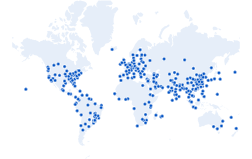
Powered by a
global network
of 310+ data centers in
Seamless
pre-built integrations,
extensive documentation,
Keep detailed consent records with audit trails while ensuring no personally identifiable information is stored, prioritising user privacy and compliance.
Target by country, state, province, or territory, then serve the right consent model and language automatically.
European Union
GDPR + ePrivacy

California
CCPA/CPRA · GPC honoured
Québec
Law 25
Keep Google, Microsoft, Meta, HubSpot, and browser-level consent signals aligned with every visitor choice.
Schedule recurring website scans to surface new cookies and trackers for review.
Embed a detailed cookie declaration that stays aligned with your latest scan.
Google Analytics
Analytics
HubSpot
Marketing
Stripe
Payments
Create fully customised banners for each province or territory — plus a Canada-wide fallback for anyone whose region can't be detected — and CookieChimp serves each visitor the matching banner automatically.
Per-region control
Independent custom banners
“CookieChimp's intuitive UI made the integration process a breeze and far easier than we've experienced with other platforms. The platform provides valuable insights into user consent, making it our top choice for cookie management.”
“I love the developer experience with CookieChimp — it was very straightforward to set up, and the scan tools help you implement it correctly. The regional banners were exactly what I was looking for, letting me choose different banner types for each region, so some places can opt in and others opt out by default. The platform integrated right into our full stack, making it a great fit for our needs.”
“The CookieChimp team has been very helpful in getting us set up and ensuring that we are following the best practice. They've helped us to achieve what we needed, and respond quickly and thoughtfully. I've used a couple of other platforms and CookieChimp is by far the most intuitive platform I've used.”
“Great product with equally great support. Dan from support has been so helpful throughout the implementation, even helping with areas which are not necessarily within his support remit. Highly recommended product and company!”
“Outstanding, such great customer service. Dan looked into, debugged and solved my problems with the plugin.”
“I have to say I've tried several cookie bar solutions before, and CookieChimp is the first one that actually let me set everything up correctly.”
“Setting up the cookie banner was really easy. I didn't have to do it alone, the CookieChimp team helped me through the whole process. They also explained the technical setup and showed me how I could use it on my website and later on a mobile app.”
“Very easy and uncomplicated setup on Next.js compared to other cookie banners like Usercentrics. Works great and pricing is very affordable.”
“The CookieChimp platform is easy to use and the customer service support has always been tremendously helpful and prompt in helping me understand the ever-changing landscape of legal requirements and keeping our site compliant. I really appreciate their expertise.”
“CookieChimp has been incredibly useful for our company. It's exactly the tool we were looking for: easy to install and works perfectly. We've been using it for two months without any issues. Their development team is also excellent, responding quickly with helpful answers whenever we need support. The documentation is excellent too: clear, concise, and with just the right amount of information, without overwhelming you with unnecessary content.”
Canada has no single universal "cookie banner required" rule. The requirement comes from privacy-law consent obligations when cookies, pixels, or SDKs collect personal information. Because online behavioural advertising usually involves personal information, a banner or equivalent notice-and-choice mechanism is the practical way to comply.
You create and fully customise an independent banner for each province or territory. CookieChimp geolocates each visitor, resolves their Canadian region — for example CA-QC, CA-ON, or CA-BC — and automatically serves the banner you've targeted there.
Necessary cookies genuinely required to deliver the requested service are treated differently from advertising, retargeting, behavioural analytics, and profiling tools. For technologies that identify, locate, or profile a person, Quebec's Law 25 should be treated as opt-in. With auto-blocking enabled and the CookieChimp tag placed before other scripts, those tools stay off until the visitor consents.
Alberta and British Columbia have their own private-sector privacy laws. For ordinary non-sensitive tracking, the practical banner can still look like a PIPEDA opt-out model: clear notice, a reasonable opportunity to decline, sensitivity analysis, and real withdrawal. Where the data use is sensitive, unexpected, or high risk, use an opt-in banner instead.
Those provinces add health-sector privacy laws. When tracking touches health information, use an opt-in banner, minimise vendors, and remove advertising trackers from sensitive pages like patient portals and booking pages. Manitoba (PHIA) and Saskatchewan (HIPA) have their own health-information rules too.
Opt-in everywhere is the safest and simplest from a risk perspective — run a worldwide opt-in banner and it applies across Canada. A more tailored setting is opt-in for Quebec and sensitive contexts, with opt-out for non-sensitive online behavioural advertising elsewhere in Canada when the OPC's conditions are satisfied.
Yes — bilingual banners are available on paid plans. CookieChimp supports English and French banners with automatic translations, so you can meet Quebec's French-language expectations. Add a French translation and browser language auto-detect serves French to French-speaking visitors, with your account's default language as the fallback.
Yes, if they serve Canadian visitors and use cookies or tracking that collect personal information. Province targeting lets an international company avoid applying the wrong Canadian consent model — most importantly, avoiding an opt-out banner in Quebec where opt-in is expected.